
HPGR carbide edge blocks improve wear resistance by protecting the most vulnerable part of the roll—the edges—where the “edge effect” causes pressure loss, material bypass, and accelerated wear. They achieve this through a combination of extreme material hardness, a protective autogenous layer, and mechanical design that prevents premature failure. Tungsten carbide HPGR edge blocks are designed to protect these vulnerable areas and help maintain the roll profile during continuous operation.
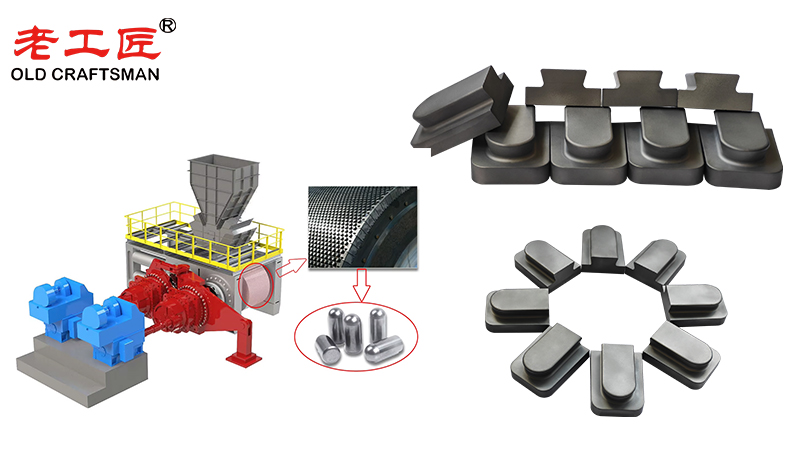
1. Why HPGR Roll Edges Wear Quickly
During HPGR operation, ore is compressed between two counter-rotating rolls. While the central roll surface is protected by wear studs and the compacted material layer between them, the roll edges experience different material-flow and pressure conditions.
Material can move toward the sides of the rolls, creating concentrated abrasive wear. If edge protection deteriorates, the roll profile can change, potentially affecting material containment and grinding consistency. Replaceable edge protection is therefore used to maintain the working profile and protect the underlying roll structure.
2. Tungsten Carbide Provides High Wear Resistance
Tungsten carbide is well suited to abrasive mining applications because cemented carbide combines very high hardness with useful wear resistance.
In HPGR applications, carbide studs and edge-protection components play an important role in determining the service life of the roll surface. Research on WC-Co HPGR studs has also shown that carbide composition and microstructure can significantly influence tribological performance and durability.
For abrasive materials such as iron ore and other hard minerals, carbide edge blocks can therefore provide a more durable wear surface than conventional steel components.
3. Protecting the HPGR Roll Structure
Edge blocks act as sacrificial wear components. Instead of allowing abrasive material to directly attack the roll edge or tire, the replaceable carbide component absorbs much of the wear.
This approach has an important maintenance advantage: when an edge component eventually reaches its wear limit, the worn component can be replaced rather than requiring replacement of the entire roll assembly.
Industrial HPGR designs commonly use replaceable edge protection specifically to extend wear life and simplify maintenance.
4. Helping Maintain a Stable Roll Profile
Consistent edge geometry is important for maintaining stable HPGR operation. Excessive or uneven edge wear can alter the effective working profile of the roll.
Well-designed edge blocks help maintain the intended edge profile during operation. Combined with appropriate roll-surface design and material containment, this can contribute to more consistent grinding conditions.
Metso, for example, describes HPGR flange systems as helping reduce edge effects, promote even wear and extend tire life.
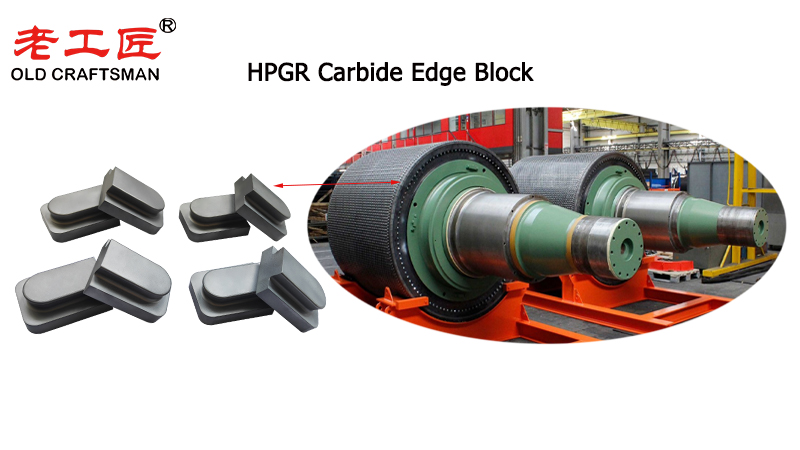
5. Working Together with the Autogenous Wear Layer
HPGR wear protection does not depend only on the hardness of the carbide.
In studded HPGR rolls, crushed feed material becomes compacted between the wear elements and forms an autogenous wear layer. This layer helps shield the roll surface from direct abrasive contact. Research and industrial experience have identified this compacted material layer as an important mechanism for extending roll-surface wear life.
Carbide edge blocks therefore work as part of a larger wear-protection system rather than as an isolated component.
6. Reduced Maintenance and Downtime
Mining operations can lose significant production time when HPGR wear components require frequent replacement or repair.
Longer-lasting edge protection can reduce the frequency of maintenance interventions and help extend service cycles. Replaceable carbide edge systems are particularly useful because individual worn components can be changed without necessarily replacing major roll components.
The practical benefits can include:
- Longer edge-component service life
- Reduced frequency of maintenance
- Better protection of expensive HPGR tires
- More stable roll geometry
- Lower risk of premature edge damage
- Improved equipment availability
- Potentially lower wear cost per tonne processed
Actual performance, however, depends on ore abrasiveness, feed characteristics, grinding pressure, roll design, carbide grade, edge-block geometry and operating conditions.
7. Why Custom Carbide Edge Blocks Matter
HPGR edge blocks are not necessarily a one-size-fits-all component. Different HPGR models and mining applications can require different dimensions, profiles, mounting arrangements and carbide grades.
A suitable edge-block design should consider:
| Design Factor | Importance |
|---|---|
| Carbide grade | Balances wear resistance and toughness |
| Carbide geometry | Determines contact and wear behavior |
| Block dimensions | Must match the HPGR roll design |
| Mounting method | Influences reliability and replacement |
| Ore characteristics | Determines abrasive and impact conditions |
| Grinding pressure | Affects mechanical loading |
| Operating environment | Influences overall wear behavior |
| Dimensional tolerances | Ensures proper installation and fit |
This is why HPGR wear-component manufacturers commonly develop carbide grades and designs according to the customer’s specific application and drawings.
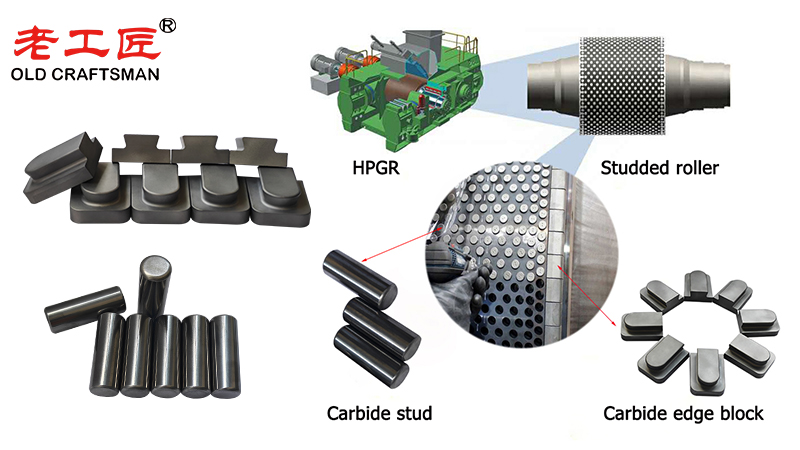
Conclusion
HPGR carbide edge blocks provide an important layer of protection for one of the most wear-sensitive areas of an HPGR roll. By combining the high wear resistance of tungsten carbide with application-specific geometry and replaceable designs, they can help protect roll edges, maintain a stable working profile and reduce maintenance requirements.
For mining operations processing highly abrasive ores, selecting the appropriate HPGR carbide edge block grade, geometry and mounting design is an important consideration when optimizing roll wear life and total operating cost.
For manufacturers such as Old Craftsman, the key is not simply producing a harder carbide component, but matching the carbide grade and edge-block design to the customer’s HPGR model, drawings and operating conditions.
Beyond HPGR Carbide Edge Block, our extensive portfolio includes a broad spectrum of solutions specifically designed for industries demanding exceptional wear and impact resistance. Our premium offerings include HPGR Wear Parts, durable mining conveyor belt cleaner, robust crusher hammer heads, specialized components for sand-making machines, protective linings for refractory brick molds, and efficient intensive mixer blades.
“Zhuzhou OC Precision Alloy Co., Ltd. could make tungsten carbide wear parts and make your equipment use life is tens of times longer than before! We specialize in providing customized carbide wear products solutions to meet the demanding requirements of industries such as aerospace, automotive, mining, and precision machining.”
Belt scraper Brazing brazingprocess carbide Carbide belt scraper carbidebrazing carbide hammer Crusher CRUSHER HAMMER HPGR HPGR feed chute liner Informational Internal stress metal mining Refractory Brick Mold Secondary belt cleaner scraper stresses VSI crusher wear plates welding