
Based on real-world field data, tungsten carbide wear plates can indeed deliver a service life 5 to 8 times longer than traditional high chromium or chromium carbide overlay plates in severe abrasive conditions.
Here is a technical breakdown of why tungsten carbide outperforms high chromium materials in those real-world tests, along with the specific scenarios where the 8x figure was achieved.
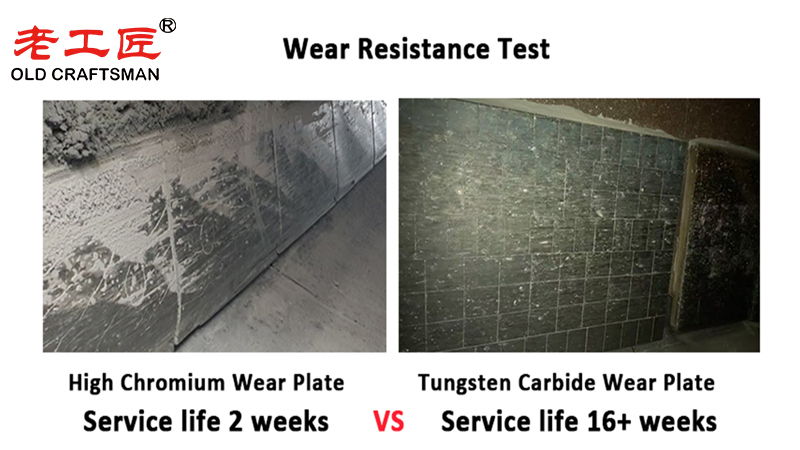
🧪 Performance at a Glance
The table below summarizes the key performance differences observed in industrial applications:
| Feature | Tungsten Carbide (WC) | High Chromium / CCO |
|---|---|---|
| Hardness | HRA 89–92 (approx. 68–72 HRC) | HRC 55–62 |
| Wear Mechanism | Uniform micro-abrasion; maintains smooth surface | Forms grooves/ridges, leading to accelerated wear |
| Reported Service Life | 8x – 13x vs. Chromium Carbide in documented case studies | Baseline (3–4 weeks in extreme cases) |
| Total Cost (TCO) | Higher upfront cost, 40–60% lower long-term cost | Lower upfront cost, high maintenance frequency |
| Best Application | Extreme abrasion (silica, slag, basalt), high transfer points | Moderate abrasion, sliding wear, complex shapes |
🏆 The Real-World Case: The 8x Figure
The “8x longer service life” claim is not just marketing—it comes from documented industrial trials.
- The Setup: A chute handling crushed slag was wearing through standard Chromium Carbide Overlay (CCO) plates every 3 to 4 weeks.
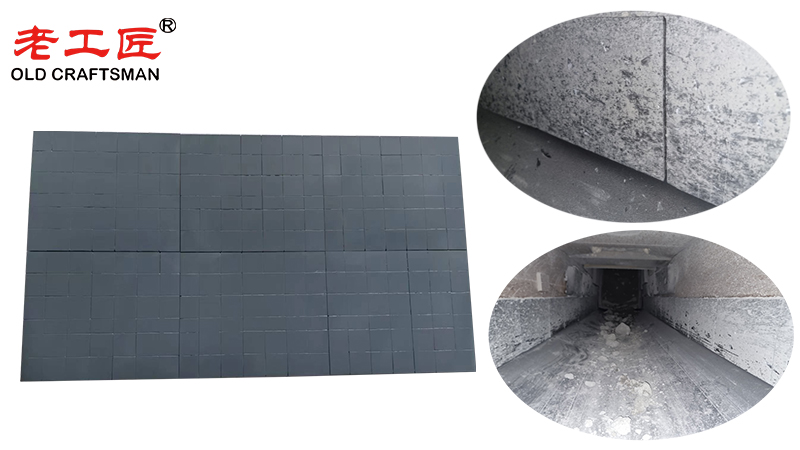
- The Switch: Operators replaced the CCO plates with Ferobide tungsten carbide wear plates (a sintered tungsten carbide composite).
- The Result: The tungsten carbide plates showed “very little wear” after 4 months. The final service life extended to 52 weeks—representing a wear life improvement of 13x to 17x compared to the previous material.
🛡️ When Tungsten Carbide Wins (The “Why”)
For the 8x figure to hold true, the environment needs to involve high-stress abrasion or sharp, hard particles (like granite, basalt, or recycled slag).
- Full-Thickness Hardness: Unlike chromium carbide overlays (which are a soft steel base with a hard welded surface), solid tungsten carbide plates maintain their hardness throughout. Once a CCO surface wears through, the soft steel underneath fails rapidly.
- Grain Structure: Tungsten Carbide grains (WC) are inherently harder than the chromium carbides (M7C3) found in high-iron alloys, making them significantly more resistant to cutting and gouging from sharp rock.
- Surface Dynamics: Overlay welding leaves a rough surface that catches material. Tungsten carbide plates stay smoother longer, preventing “hang-ups” that slow production.
⚠️ The Trade-offs: When to Stick with High Chromium
While tungsten carbide lasts longer, it is not a universal solution. High Chromium White Iron (HCWI) or CCO remains a better choice in specific scenarios:
- High Impact Zones: Tungsten carbide is very hard but brittle. If you are dealing with large rocks falling from significant heights (severe impact rather than sliding abrasion), the ductile steel backing of a CCO plate or a high-chromium casting will resist cracking better than a pure carbide plate.
- Extreme Heat/Corrosion: If temperatures exceed 600°C (1112°F) , Tungsten Carbide begins to oxidize. Chromium Carbide is chemically more stable in high-heat or corrosive environments (e.g., boiler tubes).
- Complex Shapes: Tungsten carbide plates are flat and rigid. If you need to wrap a complex chute cone or curved pipe, weldable CCO is easier to fabricate and install on-site.
🔍 How to Verify the Claim for Your Site
To prove the 8x figure on your own equipment, you can run a simple cost-per-ton analysis rather than just comparing the price of the steel:
- Document Baseline: Track how many tons of material your current High Chromium liner processes before it wears out.
- Calculate Downtime: Factor in the labor cost to cut out the old liner and weld in a new one.
- Compare: If the Tungsten Carbide plate costs 4x more but lasts 8x longer, you have effectively halved your operating cost for that chute.
“Zhuzhou OC Precision Alloy Co., Ltd. could make tungsten carbide wear parts and make your equipment use life is tens of times longer than before! We specialize in providing customized carbide wear products solutions to meet the demanding requirements of industries such as aerospace, automotive, mining, and precision machining.”
Belt scraper Brazing brazingprocess CARBDIE HAMMER carbide Carbide belt scraper carbidebrazing carbide hammer Crusher CRUSHER HAMMER Informational Internal stress metal mining Refractory Brick Mold Secondary belt cleaner scraper stresses VSI crusher wear plates welding