
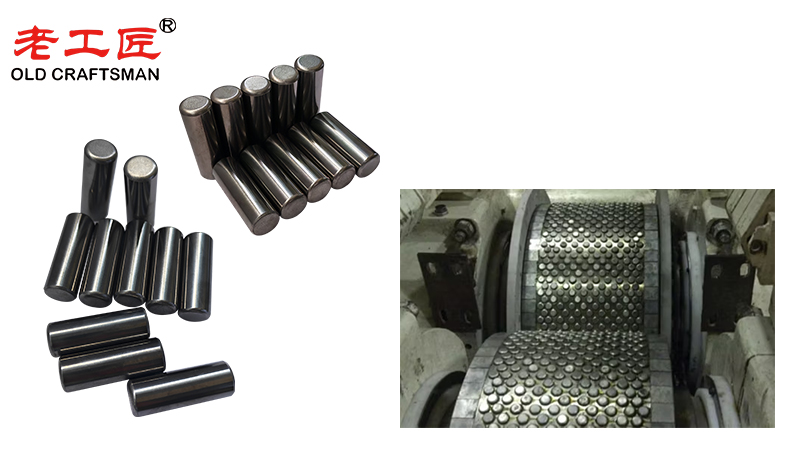
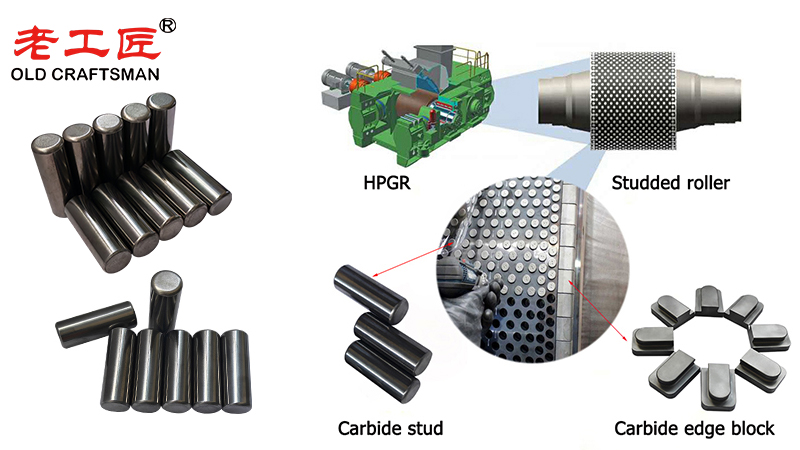
High-Pressure Grinding Rolls rely on carbide studs to maintain throughput under extreme abrasive conditions. These tungsten carbide components protect the roll surface while preserving the critical “autogenous layer” of compacted mineral particles that enables efficient inter-particle crushing.
HPGR carbide studs play a critical role in maintaining grinding efficiency, extending roll service life, and maximizing overall throughput.
1. Maintaining Stable Grinding Performance
HPGR carbide studs are designed to withstand high compressive forces, impact, and severe abrasive wear. Compared with conventional wear materials, tungsten carbide provides excellent hardness and wear resistance.
By maintaining the designed profile of the HPGR roll surface, carbide studs help keep the grinding pressure and material bed more consistent. This allows the HPGR to operate closer to its intended operating conditions and maintain stable production rates.
2. Reducing Wear-Related Downtime
Excessive wear on HPGR rolls can gradually reduce grinding efficiency and eventually require maintenance or replacement. Unplanned downtime can significantly affect mine productivity.
High-quality carbide studs provide a durable wear surface that resists deformation and material loss. Longer wear life means fewer roll maintenance intervals and more continuous operating time.
More operating hours = higher annual production capacity.
3. Supporting Higher Throughput
When the roll surface remains in good condition, the HPGR can process feed material more consistently. Properly selected carbide studs help maintain the working geometry of the roll and support efficient compression of the material bed.
For high-volume mining operations, even a small improvement in equipment availability or grinding efficiency can translate into substantial additional tonnage over the course of a year.
4. Improving Wear Resistance in Abrasive Ores
Mining materials such as iron ore, copper ore, gold ore, cement raw materials, and industrial minerals can cause severe abrasive wear.
Tungsten carbide studs combine high hardness, wear resistance, and adequate toughness, making them suitable for demanding HPGR applications. The carbide grade can also be selected according to the ore characteristics and operating conditions.
5. Lowering Total Operating Costs
The value of HPGR carbide studs should not be measured only by their purchase price. A more important consideration is the cost per ton processed.
Longer stud life can reduce:
- Roll maintenance frequency
- Replacement costs
- Production interruptions
- Labor and maintenance expenses
- Cost per ton of processed material
Therefore, a higher-performance carbide stud can provide a better overall return even when its initial price is not the lowest.
6. Why Carbide Quality Matters
Not all carbide studs deliver the same performance. Important factors include:
| Key Factor | Importance |
|---|---|
| Tungsten carbide grain size | Influences hardness and wear resistance |
| Cobalt content | Balances toughness and hardness |
| Density | Indicates material consistency |
| Hardness | Determines resistance to abrasive wear |
| TRS | Indicates resistance to breakage |
| Sintering quality | Affects overall durability |
| Dimensional accuracy | Ensures proper installation |
For demanding HPGR applications, consistent raw materials, controlled sintering, precision grinding, and strict final inspection are essential.
Maximize HPGR Performance with Carbide Wear Parts
Choosing the right HPGR carbide studs can directly influence equipment availability, wear life, maintenance frequency, and processing capacity. For mining operations focused on maximizing throughput, the goal should not simply be to purchase the cheapest studs, but to achieve the best balance of wear life, toughness, dimensional accuracy, and cost per ton.
Old Craftsman Precision Alloy supplies tungsten carbide HPGR studs and related wear components, including carbide edge blocks, cheek plates, and flanges, manufactured according to customer drawings and application requirements.
For large-scale mining and mineral processing operations, properly engineered carbide wear parts can help keep HPGR equipment running longer, more consistently, and more efficiently.
Beyond belt scrapers, our extensive portfolio includes a broad spectrum of solutions specifically designed for industries demanding exceptional wear and impact resistance. Our premium offerings include belt scrapers, durable mining wear plates, robust crusher hammer heads, specialized components for sand-making machines, protective linings for refractory brick molds, efficient mixer blades and HPGR wear parts.
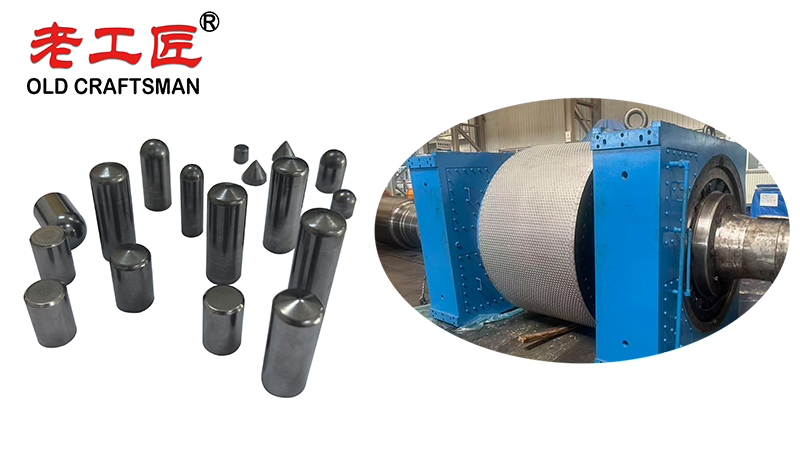
Beyond HPGR wear parts, our extensive portfolio includes a broad spectrum of solutions specifically designed for industries demanding exceptional wear and impact resistance. Our premium offerings include belt scrapers, durable mining wear plates, robust crusher hammer heads, specialized components for sand-making machines, protective linings for refractory brick molds, and efficient mixer blades.
“Zhuzhou OC Precision Alloy Co., Ltd. could make tungsten carbide wear parts and make your equipment use life is tens of times longer than before! We specialize in providing customized carbide wear products solutions to meet the demanding requirements of industries such as aerospace, automotive, mining, and precision machining.”
Belt scraper Brazing brazingprocess carbide Carbide belt scraper carbidebrazing carbide hammer Crusher CRUSHER HAMMER HPGR HPGR feed chute liner Informational Internal stress metal mining Refractory Brick Mold Secondary belt cleaner scraper stresses VSI crusher wear plates welding