
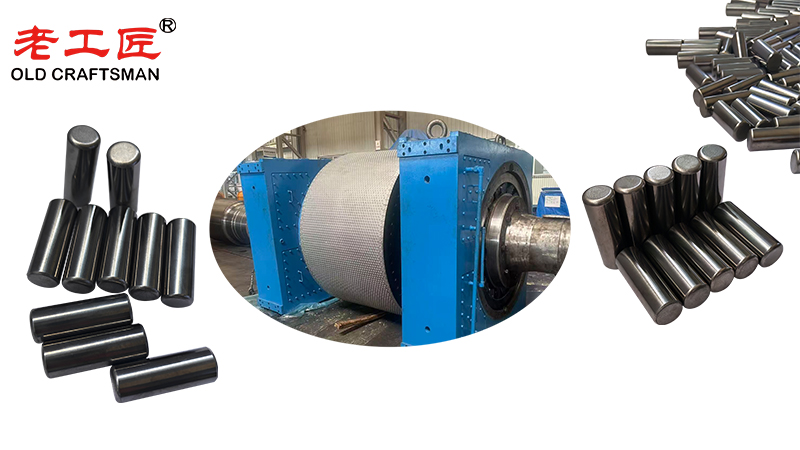
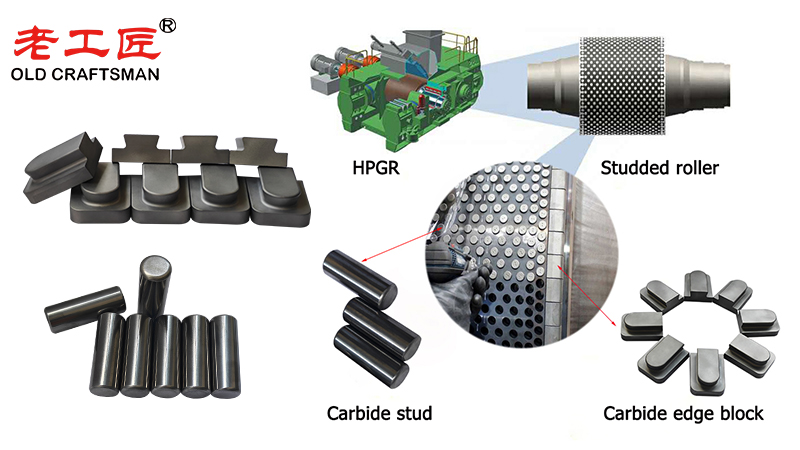
Carbide studs on High-Pressure Grinding Rolls (HPGR) are critical wear components that represent a significant portion of maintenance costs. Early failure and breakage typically stem from material selection, operational parameters, and monitoring deficiencies.
The good news is that many carbide stud failures can be reduced through proper grade selection, manufacturing quality, installation, and operating control.
1. Select the Correct Carbide Grade
Carbide studs must provide a suitable balance between hardness, transverse rupture strength (TRS), toughness, and wear resistance.
A grade with extremely high hardness may provide excellent abrasion resistance but can be more susceptible to impact-related cracking. Conversely, a tougher grade may better withstand impact but wear faster under highly abrasive conditions.
For HPGR applications, the carbide composition and microstructure should be selected according to:
- Ore abrasiveness
- Feed particle size
- Compression pressure
- Impact conditions
- Moisture content
- Roller operating speed
- Expected service life
Working with the carbide manufacturer to match the grade to the actual operating conditions is essential.
2. Control Carbide Microstructure and Material Quality
Internal defects can become starting points for cracks during HPGR operation.
High-quality HPGR studs should have:
- Uniform WC grain distribution
- Consistent cobalt distribution
- Low porosity
- Minimal abnormal grain growth
- High density
- Controlled WC grain size
- Stable mechanical properties between production batches
Processes such as vacuum sintering or Sinter-HIP can help reduce internal porosity and improve structural reliability when properly controlled.
3. Avoid Sharp Stress Concentration
Small geometric defects can create significant local stresses when the stud is repeatedly subjected to high compression and impact.
Pay particular attention to:
- Chamfer dimensions
- Edge radius
- Surface grinding quality
- Head geometry
- Dimensional tolerances
- Surface scratches and grinding damage
A properly controlled chamfer can help reduce stress concentration around the carbide edges and lower the risk of chipping.
4. Ensure Correct Stud Installation
Even a high-quality carbide stud can fail prematurely if it is incorrectly installed in the HPGR roller.
The stud pocket should have the correct:
- Diameter
- Depth
- Interference fit
- Positioning accuracy
- Surface condition
Excessive interference can generate unwanted tensile stress in the carbide, while insufficient interference may allow movement or loosening during operation.
The installation process should also prevent contamination, misalignment, and damage to the stud surface.
5. Pay Attention to the Steel Body and Stud Support
Carbide studs do not work independently. The surrounding roller material provides critical mechanical support.
Poor support around the carbide can cause:
- Stud movement
- Stress concentration
- Edge chipping
- Carbide cracking
- Stud pull-out
The design of the roller surface and stud arrangement should therefore provide sufficient mechanical support, especially in high-impact areas.
6. Control HPGR Operating Conditions
Operating conditions have a direct influence on carbide stud life.
Excessive or unstable:
- Grinding pressure
- Feed size
- Tramp metal
- Roller speed
- Material feed rate
can increase impact loading and accelerate stud damage.
Large foreign objects or uncrushable materials are particularly dangerous because they can create sudden impact loads that exceed the carbide’s mechanical limits.
7. Monitor Stud Damage Early
Regular inspection can help identify developing problems before widespread failure occurs.
Look for:
- Small cracks
- Edge chipping
- Abnormal wear
- Loose studs
- Uneven stud height
- Localized wear zones
- Changes in the roller surface profile
If failures are concentrated in one area, the problem may be related to roller loading, stud positioning, installation, or local material flow, rather than simply carbide quality.
8. Work with the Carbide Manufacturer on Failure Analysis
When premature breakage occurs, replacing the studs without identifying the root cause may lead to repeated failures.
A useful failure analysis should review:
- Carbide grade and chemical composition
- Density and hardness
- TRS or toughness data
- Metallographic structure and porosity
- Stud dimensions and chamfer
- Installation method
- Roller operating parameters
- Location and pattern of failed studs
- Photos of fracture surfaces
- Production batch and sintering records
This information can help determine whether the primary cause is material-related, manufacturing-related, installation-related, or operational.
Conclusion
Preventing premature HPGR carbide stud failure requires more than simply choosing a harder carbide grade. Material quality, microstructure, geometry, installation accuracy, roller support, and operating conditions must work together.
For demanding HPGR applications, manufacturers should focus on consistent carbide quality, controlled dimensional tolerances, appropriate toughness, and systematic failure analysis. These measures can help reduce stud breakage, improve wear performance, and extend the service life of HPGR rollers.
Old Craftsman supplies customized tungsten carbide HPGR studs and wear components, with carbide grades and dimensions tailored to different grinding applications.
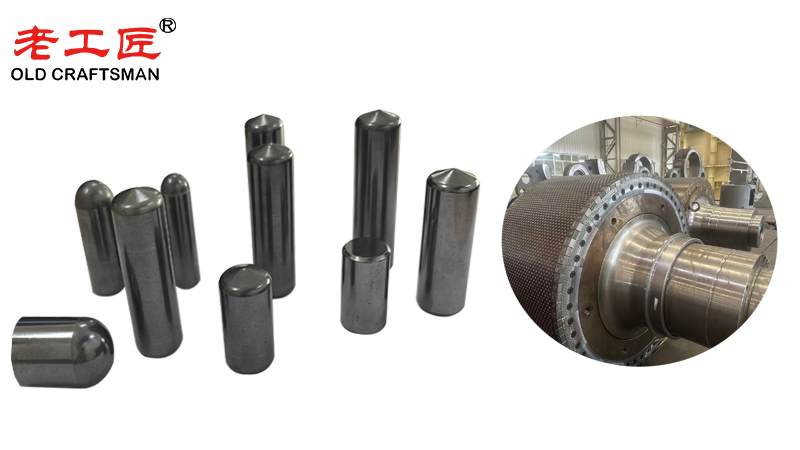
Beyond HPGR Carbide Studs, our extensive portfolio includes a broad spectrum of solutions specifically designed for industries demanding exceptional wear and impact resistance. Our premium offerings include HPGR Wear Parts, durable mining conveyor belt cleaner, robust crusher hammer heads, specialized components for sand-making machines, protective linings for refractory brick molds, and efficient intensive mixer blades.
“Zhuzhou OC Precision Alloy Co., Ltd. could make tungsten carbide wear parts and make your equipment use life is tens of times longer than before! We specialize in providing customized carbide wear products solutions to meet the demanding requirements of industries such as aerospace, automotive, mining, and precision machining.”
Belt scraper Brazing brazingprocess carbide Carbide belt scraper carbidebrazing carbide hammer Crusher CRUSHER HAMMER HPGR HPGR feed chute liner Informational Internal stress metal mining Refractory Brick Mold Secondary belt cleaner scraper stresses VSI crusher wear plates welding