
In the relentless pursuit of efficiency, modern mining operations have increasingly turned to High-Pressure Grinding Rolls (HPGR) as a cornerstone of comminution. While the massive, studded roll surfaces rightly capture most of the attention, the true, unsung heroes of consistent and profitable operation are often the smallest components: the edge blocks. As ore grades decline and operational costs rise, overlooking the critical role of carbide HPGR edge blocks is a risk no modern mine can afford to take.
To overcome this bottleneck, modern processing plants rely on carbide HPGR edge blocks. Here is a look at why these specialized wear parts are essential for keeping crushing circuits efficient, profitable, and reliable.
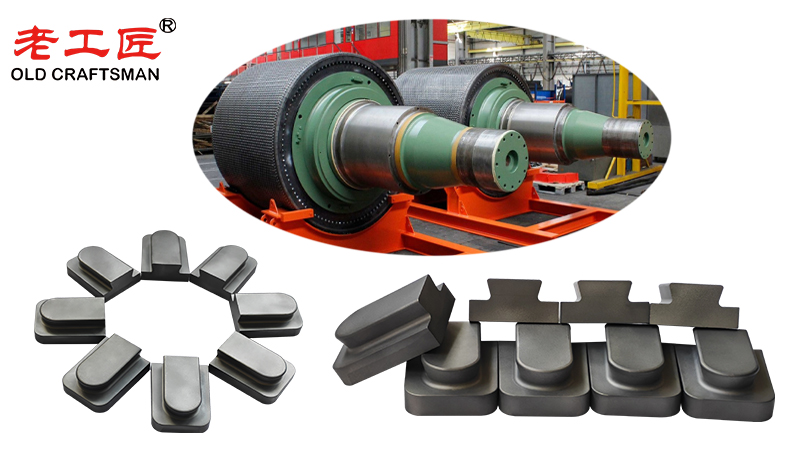
1. Eliminating the “Edge Effect”
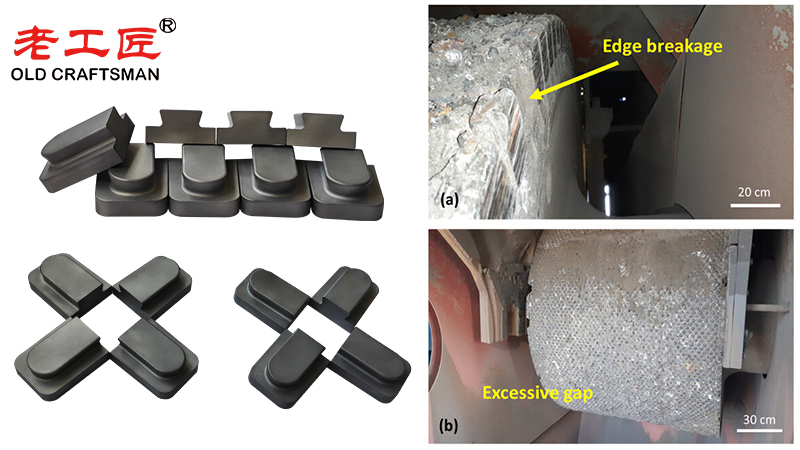
During operation, ore passes between two counter-rotating rolls under extreme hydraulic pressure. While the center of the roll maintains a solid, packed bed of rock, material near the sides naturally escapes sideways where pressure drops off. This phenomenon—known as the edge effect—leads to uneven crushing and accelerated local wear on the roll margins.
Carbide edge blocks act as high-durability cheek walls and boundary retainers. By resisting the harsh abrasive action of escaping ore, they preserve the geometric integrity of the roll edges and maintain uniform pressure distribution across the entire bed width.
2. Unmatched Resistance to Extreme Abrasion
Mining ores often contain high concentrations of silica and other highly abrasive minerals. Standard alloy steel components wear down rapidly under these conditions, leading to frequent downtime and misaligned rolls.
Carbide edge blocks utilize tungsten carbide (WC) inserts embedded within high-strength steel bodies or specialized matrix alloys. Tungsten carbide delivers exceptional hardness (often exceeding 85–90 HRA), enabling edge blocks to withstand:
- Extreme sliding abrasion from high-velocity rock particles.
- Micro-gouging and severe impact loads.
- Corrosive slumping environments in wet crushing applications.
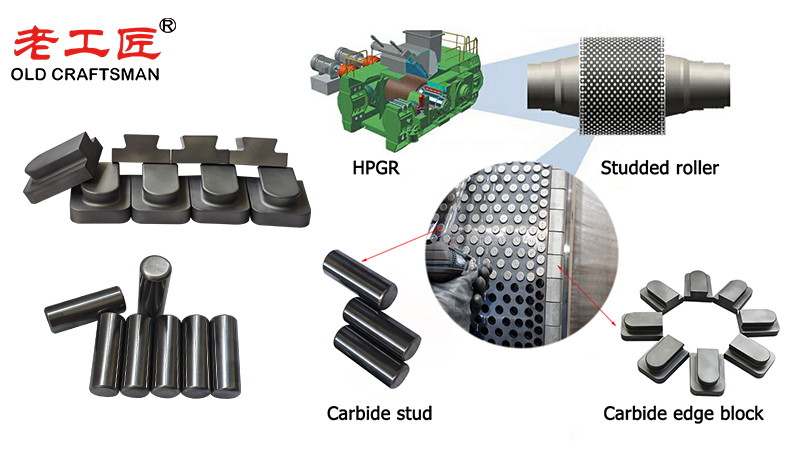
3. Extending Total Roll Service Life
An HPGR roll is only as good as its weakest section. If the edges degrade prematurely, the entire roll assembly must be taken offline for rebuilding or replacement—even if the center studs are still in excellent condition.
By installing wear-resistant carbide blocks along the perimeter, operators ensure that the roll edges wear at a rate compatible with the main tire surface. This synchronized wear profile maximizes the total operational hours of the roll tire, lowering the total cost per ton processed.
4. Maximizing Energy and Throughput Efficiency
When roll edges degrade, uncrushed or oversized material bypasses the high-pressure zone. This leads to two costly operational inefficiencies:
- Increased Recirculating Loads: Oversized ore must be recycled back through the circuit, wasting energy and decreasing net throughput.
- Sub-optimal Particle Bed Compression: Pressure loss at the edges reduces micro-cracking efficiency in the ore, increasing the energy required in downstream grinding circuits (such as ball mills or stirred mills).
Maintaining crisp, structurally sound roll boundaries with carbide blocks ensures that energy is transferred directly into rock breakage, keeping power consumption optimized.
Key Benefits at a Glance
| Feature | Operational Impact |
| Superior Hardness (Tungsten Carbide) | Dramatically reduces replacement frequency and maintenance labor |
| Edge-Pressure Retention | Minimizes bypass of oversized material and improves crushing efficiency |
| Synchronized Wear Life | Prevents premature roll tire replacement due to localized edge damage |
| Modular Design | Allows targeted maintenance of worn blocks rather than full roll overhauls |
Conclusion
Tungsten carbide HPGR edge blocks are essential wear-protection components for mining operations that need reliable equipment performance, controlled maintenance costs, and consistent production.
By choosing the appropriate carbide grade, precise geometry, and dependable manufacturing process, mining operators can improve edge protection and optimize the long-term performance of their HPGR equipment.
Beyond HPGR Carbide Studs, our extensive portfolio includes a broad spectrum of solutions specifically designed for industries demanding exceptional wear and impact resistance. Our premium offerings include HPGR Wear Parts, durable mining conveyor belt cleaner, robust crusher hammer heads, specialized components for sand-making machines, protective linings for refractory brick molds, and efficient intensive mixer blades.
“Zhuzhou OC Precision Alloy Co., Ltd. could make tungsten carbide wear parts and make your equipment use life is tens of times longer than before! We specialize in providing customized carbide wear products solutions to meet the demanding requirements of industries such as aerospace, automotive, mining, and precision machining.”
Looking for customized carbide HPGR edge blocks for your mining equipment?
Zhuzhou Old Craftsman Precision Alloy Co., Ltd. welcomes inquiries from mining companies, HPGR equipment manufacturers, and wear-part distributors. Contact us with your drawings, dimensions, and application requirements to discuss a suitable solution.
Belt scraper Brazing brazingprocess carbide Carbide belt scraper carbidebrazing carbide hammer Crusher CRUSHER HAMMER HPGR HPGR feed chute liner Informational Internal stress metal mining Refractory Brick Mold Secondary belt cleaner scraper stresses VSI crusher wear plates welding